

International Exchange
ASEAN-JAPAN
We conducted the 21st Century COE program, which started in 2006 and has promoted collaborative activities with the Asian region in cooperation with the Graduate School of Energy Science, Kyoto University. In particular, we have been holding a Sustainable Energy and Environment Conference every two years with the Graduate School of Energy and Environment (JGSEE) in Thailand. We held SEE2024 in Thonburi, Thailand in December 2024. We also have been jointly hosting the Eco-Energy and Materials Science and Engineering Symposium (EMSES) with the Rajamangala University of Technology, Thanyaburi, almost every year since its founding in 2001, and in 2025, we held the 18th EMSES International Conference at Kyoto University.
These efforts have been highly evaluated by our counterparts, Asian universities and research institutes, as well as the Japanese government and UNESCO. We participated in the UNESCO-COMPETENCE program in 2009 and have been conducting energy science education projects in ASEAN countries from 2011 to 2015 as an ODA-UNESCO support project. Furthermore, in 2017, we were authorized by UNESCO Headquarters as the “UNESCO Chair in Water, Energy and Disaster Prevention (WENDI)”, and are currently conducting international activities led by the Graduate School of Integrated Sustainability, Kyoto University. In addition, we played a central role in signing up for an MOU between the ASEAN University Network (AUN) and Kyoto University in 2009. We have been conducting projects such as student exchanges and international joint research for young researchers. In 2012, “AUN – KU Student Mobility Program toward Human Security Development”, led by the Graduate School of Agriculture (representative: Prof. Eiji Nawata), launched and has been inviting and dispatching young researchers. In 2015, the Japan-ASEAN Science, Technology and Innovation Platform (JASTIP) was adopted as part of the JST Strategic International Joint Research Program led by the Center for Southeast Asian Studies (representative: Prof. Yasuyuki Kono). We have been actively conducting joint research between Japan and ASEAN to this day, advancing the creation of an international joint research platform with ASEAN. In addition, in 2024, we launched the Science, Technology and Innovation (STI) Coordinator Training Project in cooperation with AUN and JICA under the endorsement of the ASEAN Secretariat’s Committee on Science, Technology and Innovation (COSTI) with financial support from the ASEAN Fund. We are actively conducting collaboration research and education in the ASEAN region.
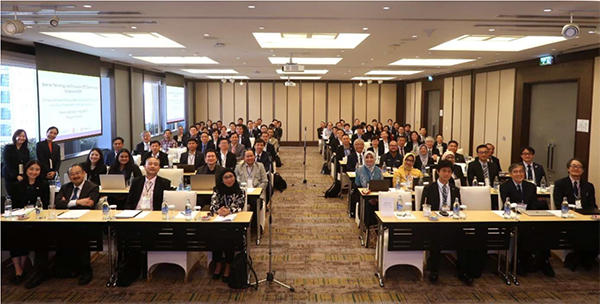
Group photo of Kick Off Symposium of STI Coordinator training program in Bangkok, Thailand (2025.3.3)https://www.youtube.com/embed/yU3A4tofdo4
Human Capacity Building for Science, Technology, and Innovation Coordination between ASEAN and Japan towards Grand Challenges
Although the ASEAN region strives to become the world’s fourth-largest economy by 2030, common challenges such as climate change, natural disasters, and energy security risks pose significant threats to sustainable economic growth, making it essential to address these issues for long-term sustainable development in the region.
To find effective scientific solutions to these problems, collaboration among various stakeholders, including research and education institutions, government ministries, local communities, and private sectors, is necessary. However, currently, there are few human resources capable of coordinating Science, Technology and Innovation (STI) projects among various stakeholders, and there is no system for training them.
In light of this situation, we have begun to build a sustainable ASEAN-Japan STI collaboration platform led by the ASEAN University Network (AUN) in collaboration with the Japan-ASEAN Science, Technology and Innovation Platform (JASTIP), Kyoto University, and AUN/SEED-Net under the support of the Japan-ASEAN Integration Fund (JAIF) to foster the next generation of STI leaders in STI Coordination by empowering them to play a crucial role in consistently promoting collaborative research and cooperative education between ASEAN and Japan. Additionally, we aim to create an effective ecosystem for institutional capacity building in STI.
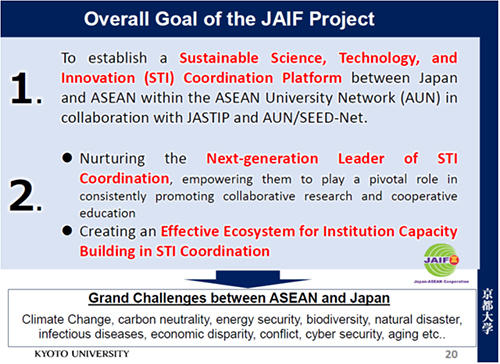
Goals of the Project
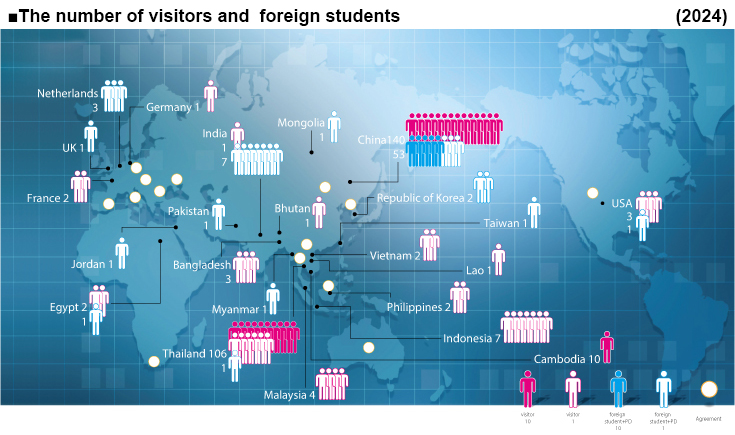
List of International Agreements
| Date signed | Name of Institute | Country |
|---|---|---|
| Mar. 22. 2024 | Korea Institute of Fusion Energy | Korea |
| Feb. 28. 2024 | The University of Jordan, The Hamdi Mango Center for Scientific Research | Jordan |
| Feb. 09. 2024 | Thailand Institute of Nuclear Technology | Thailand |
| Jan. 23. 2024 | The Institute of Sustainable Energy, Universiti Tenaga Nasional | Malaysia |
| Jan. 22. 2024 | The Institute of Energy and Sustainable Development, Zhejiang University of Technology | China |
| Jan. 22, 2024 | Institute for Carbon Neutrality, Zhejiang University | China |
| Sept. 25. 2023 | Department of Applied Physics and Science Education, Eindhoven University of Technology | Netherlands |
| June 8. 2022 | Faculty of Science, Assiut University | Egypt |
| Oct. 30. 2019 | International Joint Research Laboratory of Magnetic Confinement Fusion and Plasma Physics (IFPP), Huazhong University of Science and Technology | China |
| Oct. 21. 2019 | Center for Fusion Science, Southwestern Institute of Physics | China |
| June 19. 2019 | Faculty of Engineering, National University of Laos | Lao |
| Feb. 15. 2019 | The Institute of Fusion Science, Southwest Jiaotong University | China |
| Jan. 8. 2019 | Max-Planck-Institut fuer Plasmaphysik | Germany |
| Oct. 6. 2014 | Horia Hulubei National Institute of Physics and Nuclear engineering, Romania | Romania |
| Sep. 18. 2014 | Center for Advanced Material & Energy Sciences, University Brunei Darussalam | Brunei Darussalam |
| Jan. 23. 2013 | Fusion Plasma Transport Research Center, Korea Advanced Institute of Science and Technology | Korea |
| Apr. 12. 2012 | Nano and Energy Center, Vietnam National University, Hanoi | Viet Nam |
| May. 18. 2010 | City University of New York | U.S.A. |
| Oct. 19. 2009 | The Joint Graduate Scholl of Energy and Environment of King Mongkut’s University of Technology Thonburi | Thailand |
| Nov. 28. 2006 | The Institute of Industrial Science and Technology, College of Engineering, Pukyong National University | Korea |
| Jul. 24. 2001 | Department of Materials Science and Engineering of the University of Erlangen-Nurnberg | Germany |
| May. 16. 2001 | Centro de Investigaciones Energticas, Medioambientales y Tecnolgicas (CIEMAT) | Spain |
| Feb. 5. 2001 | Rajamangala University of Technogy | Thailand |
| Jan. 25. 2001 | Slovak University of Technology (Faculty of Electrical Engineering and Information Technology) | Slovakia |
| Jan. 9. 2001 | University of Sydney (School of Physics) | Australia |
| Sep. 10. 2000 | Korea Basic Science Institute | Korea |
| Jul. 4. 2000 | Faculty of Engineering, Dong-Eui University | Korea |
| May. 7. 1999 | Dong-Eui University (Industry-University Cooperation Center) | Korea |
| Aug. 1. 1998 | Politecnico di Torino (Materials Science and Chemical Engineering Department) | Italy |
| May. 11. 1998 | National Science Center (Institute of Plasma Physics, Kharkov Institute of Physics and Technogy) | Ukraine |
| Feb. 06. 1998 | University of Wisconsin-Madison (Torsatron/Stellarator Laboratory) | U.S.A. |
| Aug. 10. 1997 | Australian National University (Plasma Research Laboratory) | Australia |
| Dec. 12. 1996 | The Flinders University of South Australia | Australia |
| Nov. 20. 1996 | Stanford University (The Stanford Free Electron Laser Center at the Hansen Experimental Physics Laboratory) | U.S.A. |
| Nov. 19. 1996 | University of California (Center for Beam Physics, Lawrence Berkeley National Laboratory) | U.S.A. |
| Jun. 4. 1996 | China Institute of Atomic Erergy | China |
| Jun. 3. 1996 | Academia Sinica (Institute of High Energy Physics) | China |
| Sep. 29. 1995 | University of Wisconsin (Fusion Technology Institute) | U.S.A. |