


Green Catalysis and Material Conversion
Advanced Energy Conversion Division Green Catalysis and Material Conversion Research Section
Professor : Masazumi TAMURA
Associate Professor : Takashi NAKAJIMA
Program-Specific Associate Professor : Yusuke KITA
Program-Specific Assistant Professor : Pengru CHEN
We are developing innovative catalytic materials that efficiently convert energy resources such as carbon dioxide and biomass, aiming to realize a carbon-neutral and carbon-circulating society.
https://catalysis.iae.kyoto-u.ac.jp/english
1) Development of chemical fixation technologies for CO2
~Development of solid catalytic materials and processes for synthesis of value-added chemicals from CO2~
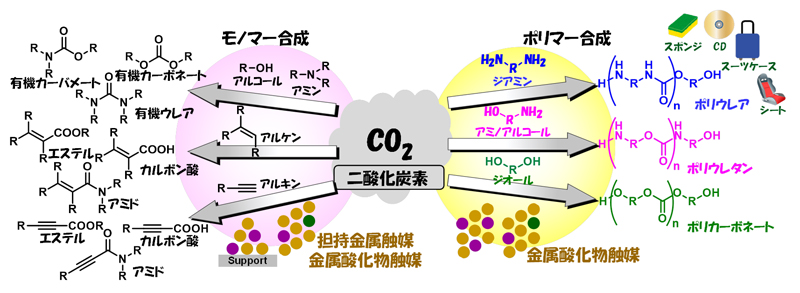
As environmental issues associated with global warming become increasingly serious, the development of technologies for CO2 mitigation is a top priority for realizing a sustainable society. Our laboratory focuses on the non-reductive transformation of CO2 and is developing highly efficient solid catalytic processes to convert it into valuable chemicals.
Synthesis of value-added chemicals from CO2
CO2 is regarded as a C1 carbon feedstock, and by activating CO₂, we develop highly functional catalytic systems capable of converting it into a variety of value-added chemicals.
2) Development of chemical recycling (upcycling) technologies for waste plastics
~Development of catalytic materials and processes for synthesis of chemicals via selective plastic conversion~
Addressing waste plastic issues, including marine pollution and microplastics, has become a global challenge. Our laboratory aims to establish recycling technologies that form the foundation of a carbon-circulating society by developing innovative solid-catalytic processes that convert waste plastics into high-value chemicals, such as lubricants.
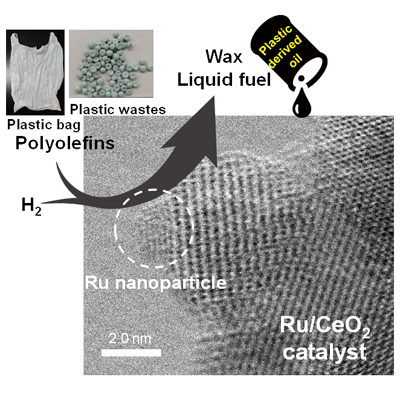
Nanoparticle catalysts and polyolefin transformation
Ruthenium supported on cerium oxide (Ru/CeO₂) possesses Ru nanoparticles at the ~1 nm scale and exhibits high activity for the conversion of polyolefins. Under mild reaction conditions (low temperature and low pressure), the catalyst selectively produces value-added chemicals such as lubricants and waxes.
3) Development of high-efficiency biomass conversion technologies
~Development of catalytic materials and processes enabling highly active and selective conversion of biomass-derived compounds~
Due to concerns over the depletion of fossil resources, the effective utilization of biomass—the only renewable organic resource—is essential for achieving carbon neutrality. Our laboratory designs innovative catalytic systems to convert unused biomass into valuable chemicals, aiming to establish fundamental technologies for sustainable manufacturing.
4) Fabrication of heterogeneous catalysts through atomically precise design.
~Development of technologies for controlling catalytic functions via atomic-level elemental arrangement
We design and construct heterogeneous catalytic materials, such as supported metal catalysts and metal oxide catalysts, in which various elements—particularly metal species that strongly influence catalytic properties—are precisely arranged at the atomic level. Through this approach, we create new catalytic functions and physicochemical properties and explore their practical applications.